
The Outdoor Apothecary is reader-supported. When you buy through links on our site, we may earn an affiliate commission. Learn more
What to Forage in July
July is loud.
Not in a bad way. But after the quiet unfolding of spring — those first tentative green shoots, the hush of early morning walks with cold mud underfoot — July just roars into being. The roadsides are waist-high. The fields are buzzing. Everything is blooming at once, and if you’re not paying attention, you’ll miss half of it.
This is one of my favorite months to be outside. I live near Pachaug State Forest in eastern Connecticut, and July here is generous almost to the point of being overwhelming. There’s so much happening. So much worth noticing and gathering.
In Nipmuck, the summer season is called Nepinnae — a word that carries a sense of abundance, of the land in full expression. That’s July. Everything the earth has been working toward since snowmelt is here now, ripening and opening and offering itself.
When considering what to forage in July, remember to explore various habitats, as different regions will yield different finds in terms of edible plants and herbs.
Getting started
If you’re new to foraging, this is actually a wonderful time to begin. Many summer plants are large, distinctive, and easy to identify. Understanding what to forage in July will enhance your experience. The light is long and generous. There’s time to go slowly.
A good regional field guide makes an enormous difference — I recommend starting with something specific to the Northeast rather than a general North American guide. And there’s no substitute for learning in person, whether with an experienced forager, a local herbalism class, or just a community of people who share what they know. The Herbal Academy has excellent online courses if in-person isn’t an option.
Start with one plant. Learn it completely. Then add another.
That’s always how it begins.
The flowers of early July
Elderflower
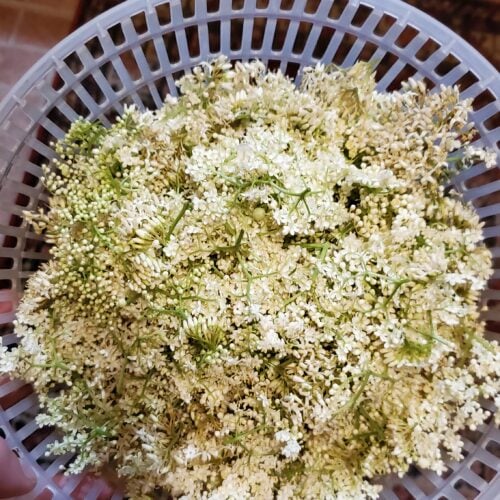
If you haven’t already gathered your elderflowers, early July is your last real window. The elder (Sambucus canadensis) blooms in flat-topped clusters of tiny white flowers, and the scent is something you’ll remember. Slightly sweet, slightly musky — unmistakably summer.
I look for elder along wet edges: stream banks, the margins of low-lying fields, hedgerows near water. She likes her feet damp. I find good patches near Pachaug Pond, right in my own backyard of eastern Connecticut — that low, wet corridor is exactly what elder is looking for.
For actual harvesting, I’m planning a trip to Norcross Wildlife Foundation in Wales, Massachusetts — over 8,200 acres of Nipmuck ancestral homeland. As a member of the Chaubunagungamaug Band of Nipmuck Indians, I’ve been invited to forage there, and I’m looking forward to it more than I can say. Foraging isn’t permitted in Avalonia Land Conservancy properties nearby, and I respect those rules. But knowing there is land — our land — where I can gather the way my ancestors gathered is something I don’t take lightly.
Harvest when the flowers are fully open but before they’ve started to brown. Give the heads a shake to knock loose any insects, and use them fresh that day if you can. Elderflower cordial is the obvious choice, and it’s worth making at least once. But I also love the flowers steeped into honey, or infused into a simple oxymel for winter colds. The flowers and the berries are different medicines, and both are worth knowing.
A note: don’t harvest every cluster on a plant. The flowers you leave behind will become berries by September. I think of it as choosing which gift to receive this season.
Linden flower
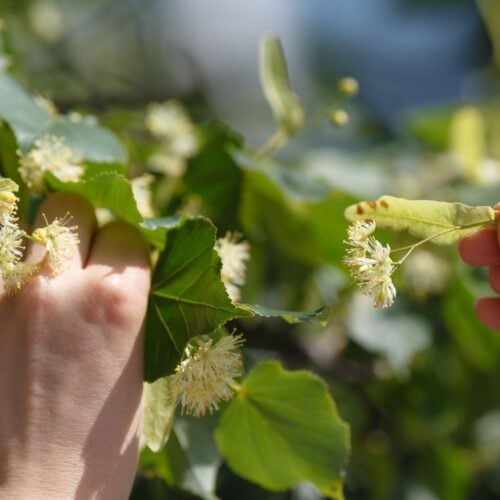
This one surprises people. The linden tree — also called basswood (Tilia americana) — blooms in early July, and most folks walk right under it without knowing. The flowers are small and pale yellow, hanging from a distinctive wing-shaped bract that makes them easy to identify once you know what to look for. The scent, on a warm afternoon, is extraordinary. Sweet and honeyed and a little dreamy.
I’ve found linden growing near Pachaug Pond — tucked in along the edges where the canopy opens up and the light comes through. Once you know the leaf shape and that unusual bract, you start to see it everywhere you weren’t looking before.
Linden is a nervine. A calmer. A tea made from the dried flowers is one of the gentlest things you can offer someone who is anxious or overheated or having trouble sleeping. Traditional European herbalism has always known this. My ancestors knew their own native lindens the same way.
The window is brief — maybe two weeks, sometimes less. When the flowers are fully open and fragrant, harvest gently and dry them quickly. They lose their medicine fast if left damp.
Look up next time you’re in a park or old neighborhood. Linden trees are often planted as street trees and in town commons. That old tree you’ve always walked past might be about to bloom.
St. John’s Wort
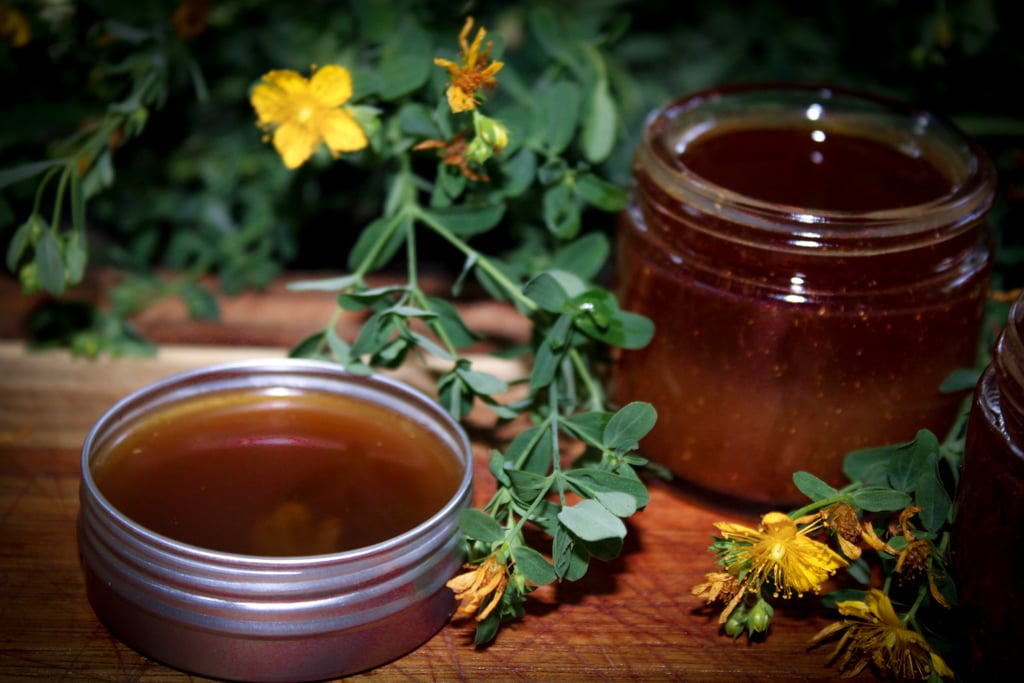
I look for this one right after the solstice. Hypericum perforatum blooms in July along roadsides, in disturbed fields, on sunny slopes — little five-petaled yellow flowers that seem almost to capture the light. Hold a leaf up to the sky and you’ll see the tiny translucent dots that give it its name: “perforatum,” perforated.
Harvest the buds and flowers when they’re just beginning to open. Pinch them between your fingers. If they stain your fingertips red-purple, that’s the hypericin, and that’s what you’re looking for.
I make infused oil every summer. It takes the whole season — flowers packed into a jar of olive oil, sitting in a sunny window, slowly turning deep red. I make a salve with the oil and use it for bruises, nerve pain, sore muscles. It’s one of those preparations that feels both old and completely reliable.
St. John’s Wort grows abundantly and spreads readily. It’s one of the plants I harvest without guilt.


High summer abundance
One of the most delightful aspects of what to forage in July is the variety of flowers available. Each offers unique flavors and medicinal properties.
Bee balm
Another plant to consider when thinking about what to forage in July is bee balm, which has a rich history and numerous uses.
July roadsides and forest edges in Connecticut come alive with Monarda — bee balm, wild bergamot, Oswego tea. The native red-flowered Monarda didyma has been used by Indigenous peoples throughout the Northeast for centuries. The Oswego people gave their name to one of its oldest documented uses as a tea.
The flavor is bold. Spicy, almost oregano-like, with a floral edge. I use it fresh and dried: in teas, in herbal vinegars, occasionally in food. It’s a carminative, an antimicrobial, useful for supporting digestion and easing the kind of respiratory congestion that lingers through summer.
More than anything, I love bee balm because it belongs here. It’s native. It feeds the hummingbirds and the native bees and the swallowtails without anyone planting it. Finding it in bloom always feels like a small proof that the land is still doing what it’s always done.
Yarrow
What to forage in July also includes the resilient yarrow, making it a vital addition to your harvesting list. Yarrow blooms all summer, but July is when I really lean into it. The flat-topped white flower clusters are everywhere — along trails, in dry meadows, at the edges of fields. If you know yarrow, you know it’s one of the most generous plants in the summer landscape.
I’ve written about yarrow at length elsewhere on this blog, so I won’t repeat myself here. But it earns its place on this list because July is peak harvest time: leaves, stems, and flowers all at their most potent. Dry bundles for winter use. Tincture the fresh plant if you can. Yarrow is a plant worth having in abundance.
Mullein flowers
By July, the tall second-year mullein stalks (Verbascum thapsus) are starting to open their small yellow flowers, a few at a time, from the bottom of the spike upward. It’s slow. Patient. You have to visit the same stalk more than once to gather enough.
Mullein flowers infused in olive oil is a traditional remedy for ear discomfort — one of those things I make a small batch of every summer and use more often than I expect to. The flowers are also gently expectorant and have been used for respiratory support for centuries.
Mullein is a pioneer plant. It grows in poor, disturbed, compacted soils — roadsides, gravel edges, recently cleared land. I never worry about over-harvesting it.
Queen Anne’s Lace
The roadsides of July belong to Queen Anne’s Lace (Daucus carota), those lacy white umbels swaying in the heat. It’s wild carrot — an introduced plant that has naturalized throughout New England and grows in staggering abundance.
A word of caution first: Queen Anne’s Lace has look-alikes, and some of them are dangerous. Poison hemlock and water hemlock are both in the same family. Before you harvest anything, learn identification carefully. The hairy stems, the central purple floret, the carrot smell of crushed leaves and root — these are your guides. When in doubt, leave it alone.
That said, confidently identified Queen Anne’s Lace offers a lot. The flowers make a beautiful infused vinegar. The seeds, harvested later in summer, have a long history of use as a carminative and were traditionally used by women as an herbal contraceptive — though I’d approach that last use with real caution and research.
I mostly appreciate it for its abundance and its presence. It’s a July plant in the truest sense.


The berries of July
If there’s one thing that gets me out the door in July without hesitation, it’s berries.
Wild blueberries, huckleberries, and raspberries all ripen this month in Connecticut, and the difference between wild and cultivated is not small. Wild blueberries are smaller, more intense, almost jammy with flavor. Huckleberries — which many people mistake for blueberries — have a slightly earthier taste and those telltale seeds you notice when you bite down. Raspberries need no explanation. You smell them before you see them on a hot afternoon.
I find all three near me hidden in my “secret” foraging spots. The blueberries and huckleberries tend toward open, acidic areas — rocky outcrops, heath edges, the kind of scrubby sunny ground that many other plants avoid. Raspberries are bolder. They colonize disturbed edges, old clearings, roadsides. They want full sun and they’re not shy about claiming it.
The huckleberry I forage in New England is black huckleberry, Gaylussacia baccata. It grows right alongside lowbush blueberry in the same rocky, acidic soil and ripens at the same time. I gather them together, mixed in the same basket, and use them interchangeably in recipes. Honestly, I’m not sure my jam or muffins would taste any different if I sorted them out. The combination just tastes like July.
I eat alot of what I pick on the walk home. What I manage to bring back I freeze or turn into jam, or fold into muffins and pancakes on a slow Sunday morning. But honestly, the eating-as-you-go is the real harvest.
Berries are a delicious reminder of what to forage in July.

The kitchen garden of summer weeds
Purslane
Purslane is another excellent choice when considering what to forage in July, known for its nutritional benefits and culinary versatility. Pull up a garden bed in July and there it is — succulent little stems, fat oval leaves, lying flat against the soil. Most people curse it as a weed. I get excited.
Purslane (Portulaca oleracea) is one of the highest plant-based sources of omega-3 fatty acids you can eat. It’s mild, slightly mucilaginous, with a faint lemony tang. I eat it fresh in salads, tossed with cucumbers and feta and olive oil, or fermented with a little salt.
It’s an introduced plant and an enthusiastic one. Harvest freely. You won’t make a dent.
Lamb’s Quarters
For anyone curious about what to forage in July, lamb’s quarters should be on your radar.
Lamb’s quarters (Chenopodium album) is another one that grows in abundance anywhere the soil has been disturbed. Young plants in July are tender and mild — I use them anywhere I’d use spinach. Sautéed with garlic. Stirred into soup. Added to a frittata or quiche.
The leaves are high in calcium and iron. They have a slightly powdery coating on new growth — totally normal, totally harmless. Worth knowing.
A note on how I forage in July
July can make you greedy. The abundance is real, and it’s easy to want to gather everything all at once.
I try not to do that.
I grew up understanding the natural world as alive and relational. The plants, the water, the soil, the animals — they aren’t just things. They have their own place, their own purpose, their own right to exist. The land is not a backdrop to our lives. It is a living presence we are in constant relationship with.
Reciprocity isn’t a concept to me — it’s a practice. Before I harvest, I leave a pinch of tobacco. I say thank you — to the plant, to the tree, to whatever I’m taking from. I speak to them the way I would speak to a friend. Once you slow down and pay attention — season after season, in the same places — you begin to notice. The plants respond to care. They have preferences, patterns, deep relationships with the soil and insects and light around them. And with you.
In practice: I never harvest more than a third of any wild plant. I spread my gathering across multiple patches. I leave plenty behind. And I spend at least as much time witnessing as I do gathering.
The plants are not here for us. They are here with us.
Don't Forget to Subscribe to Our Newsletter

Are you passionate about connecting with nature and exploring the world of herbal remedies? Join our community by subscribing to our weekly newsletter! As a subscriber, you’ll gain exclusive access to our members-only freebie and resource library, packed with valuable guides, recipes, and tips for living a more natural and sustainable lifestyle, closer to nature.
Disclaimer:
The Outdoor Apothecary website is intended for informational purposes only and should not be considered a substitute for professional medical advice. The information provided is not intended to diagnose, treat, cure, or prevent any disease. While we strive to provide accurate and up-to-date information, it is the reader’s responsibility to ensure proper plant identification and usage.
Please be aware that some plants are poisonous or can have serious adverse health effects. We are not health professionals, medical doctors, or nutritionists. It is essential to consult with qualified professionals for verification of nutritional information, health benefits, and any potential risks associated with edible and medicinal plants mentioned on this website.
