
The Outdoor Apothecary is reader-supported. When you buy through links on our site, we may earn an affiliate commission. Learn more
What to Forage in October: discover 10 wild foods to harvest in New England, from rose hips and autumn olive to acorns, chestnuts, wild grapes, and more.
October is one of my favorite months to forage in New England. The landscape is changing almost daily now. Leaves are turning gold and red, the fields are beginning to quiet down, and the forest floor is filling with nuts, berries, fruits, and other wild foods.
There’s a feeling of abundance in October, but it is a different kind of abundance than we find in spring and summer. The tender greens and flowers are mostly behind us. Instead, the landscape is offering concentrated foods meant to carry both wildlife and people through the coming cold months.
I find myself slowing down when I forage in October. I’m looking beneath trees for nuts, scanning hedgerows for colorful fruits, and revisiting familiar places to see what has ripened since my last visit.
As part of my monthly foraging series, I’ve put together some of the wild foods I look for in October here in New England.
A note before you forage: Always positively identify a wild plant before consuming it. Harvest only from clean areas away from roadsides, sprayed land, and other sources of contamination. Take only what you need and leave plenty for wildlife and the plants themselves.
Rose Hips
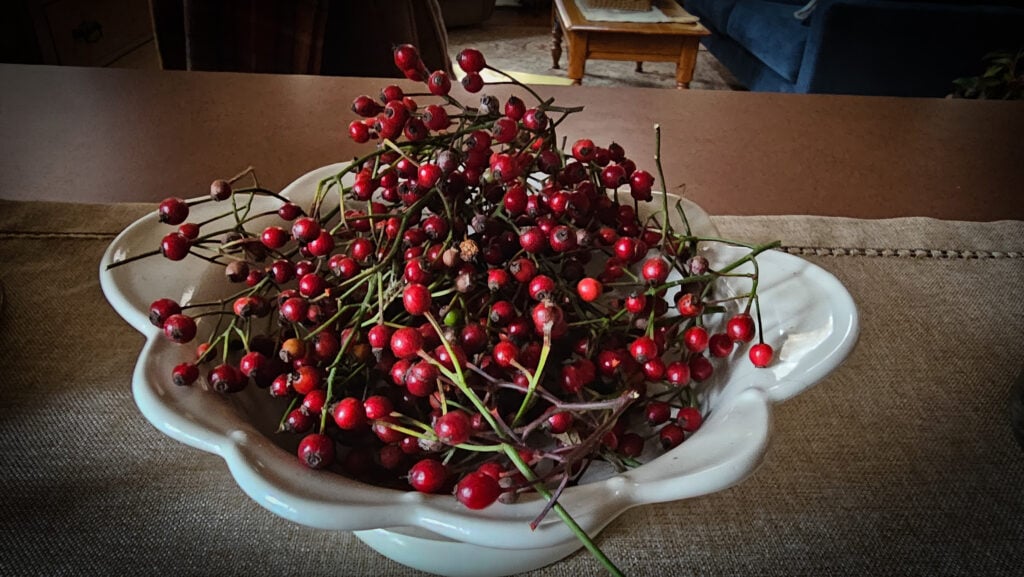
By October, wild roses have given up their flowers and are putting their energy into their bright red-orange hips.
Rose hips are one of those autumn harvests that can easily be overlooked. I particularly like finding them after the first few cool nights, when the hips have become plump and colorful.
Look for firm, red to orange-red fruits on wild rose shrubs. The leaves and prickly stems help make the plant recognizable, but I always recommend learning to identify the particular rose species in your area rather than relying on the fruit alone.
Rose hips have a naturally tart, fruity flavor and can be used for tea, syrup, jelly, sauces, and other preparations. I’ve also written about ways to use rose hips, including some of my favorite ways to preserve and enjoy this seasonal harvest.
One of my favorite preparations is a Wild Rose Hips Oxymel, which combines the tartness of rose hips with honey and vinegar.
The inside of the hip contains numerous small, hairy seeds, which should be removed or strained before eating because the hairs can be irritating.
I love that these little fruits seem to hold onto the last bit of summer even as everything around them is preparing for winter.

Highbush Cranberry
Highbush cranberry is another wonderful October find.
Despite its common name, American cranberrybush (Viburnum opulus var. americanum) isn’t a true cranberry. It is a viburnum, but the bright red fruits have a cranberry-like tartness and can be used in many of the same ways.
The clusters of red berries are especially striking against the changing foliage. Depending on the year and location, they may remain on the shrubs well into the colder months.
I like to use these tart fruits in cooked preparations, where their acidity really shines. They can be made into sauces, jellies, and other preserves and pair beautifully with sweeter autumn fruits.
I’ve also written about the plant’s deeper cultural history in Cranberrybush Folklore, Meaning & Uses. Learning the folklore and traditional uses of plants is one of my favorite ways to deepen my relationship with the species I encounter while walking through the landscape.
This is one of those plants I think is worth learning even if you don’t plan to harvest it. The shrub provides food for wildlife and adds beautiful seasonal color to the landscape.
Autumn Olive
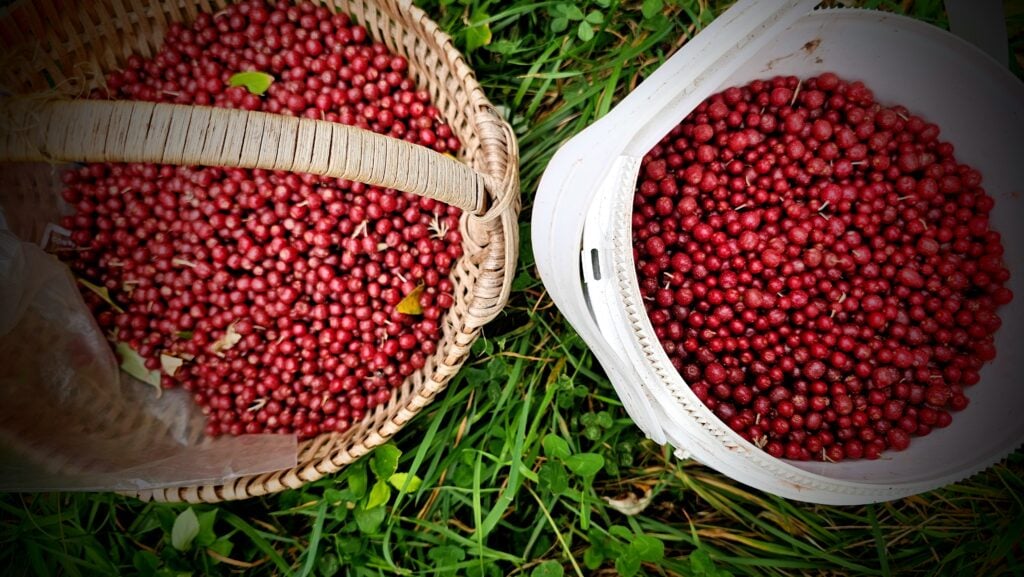
If there is one fall berry that I always look forward to, it is autumn olive (Elaeagnus umbellata).
These small red berries, covered in characteristic silvery speckles, ripen from late summer into September and October. Autumn olive is an introduced invasive shrub, and because it can be extremely prolific, I have no hesitation about harvesting plenty of its fruit where it is abundant.
I look for autumn olive along sunny woodland edges, old fields, disturbed areas, and other open places. The silvery undersides of the leaves are one of the easiest clues to recognizing the plant.
The berries should be soft and plump when ripe. Don’t rely on color alone—an underripe berry can be intensely astringent.
If you haven’t worked with autumn olive before, it is worth taking some time to learn the plant before harvesting. Once ripe, the berries are wonderfully tart and fruity, and I enjoy turning them into preserves and other treats.
Because autumn olive is invasive, I do have one important harvesting rule: don’t spit the seeds onto the ground. If you don’t want to swallow the seeds, carry a small container for them so you don’t inadvertently help spread the plant.
Crabapples
Crabapples are another autumn treasure that I think deserves far more attention.
You can find crabapple trees in old orchards, cemeteries, abandoned homesteads, parks, fields, and along woodland edges. I’ve found some of my favorite trees in unexpected places, and discovering a loaded crabapple tree always feels like finding a little piece of forgotten history.
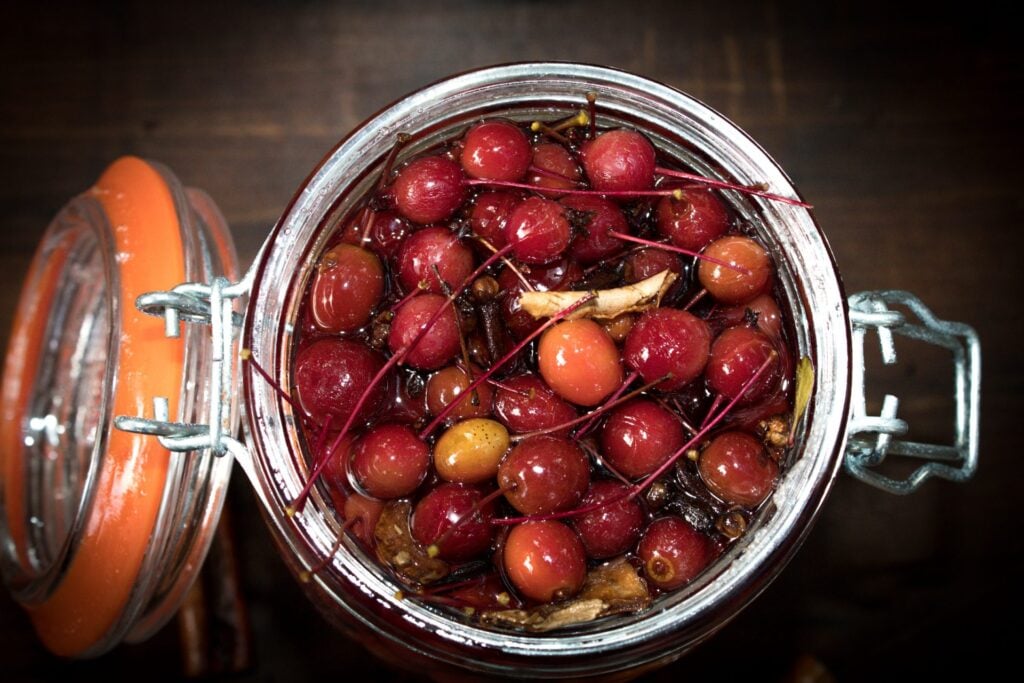
The small fruits can vary considerably in size and color, from yellow and orange to rosy red. Crabapples in the Malus genus are edible, although some varieties are much more pleasant to eat than others. I always taste one before gathering a large quantity to see what I’m working with.
Most crabapples are too tart for me to simply eat out of hand, but that tartness makes them wonderful for cooking and preserving. They’re naturally high in pectin, which makes them especially useful for jellies, jams, and other preserves.
I’ve written more about this overlooked fruit in Magical Crabapple: The Folklore & How to Use This Underappreciated Fruit.
Hickory Nuts
October is nut season in earnest, and hickory nuts are high on my list.
Several hickory species occur in New England, including shagbark hickory (Carya ovata). Once you learn to recognize the trees, you can often find nuts scattered beneath them in autumn.
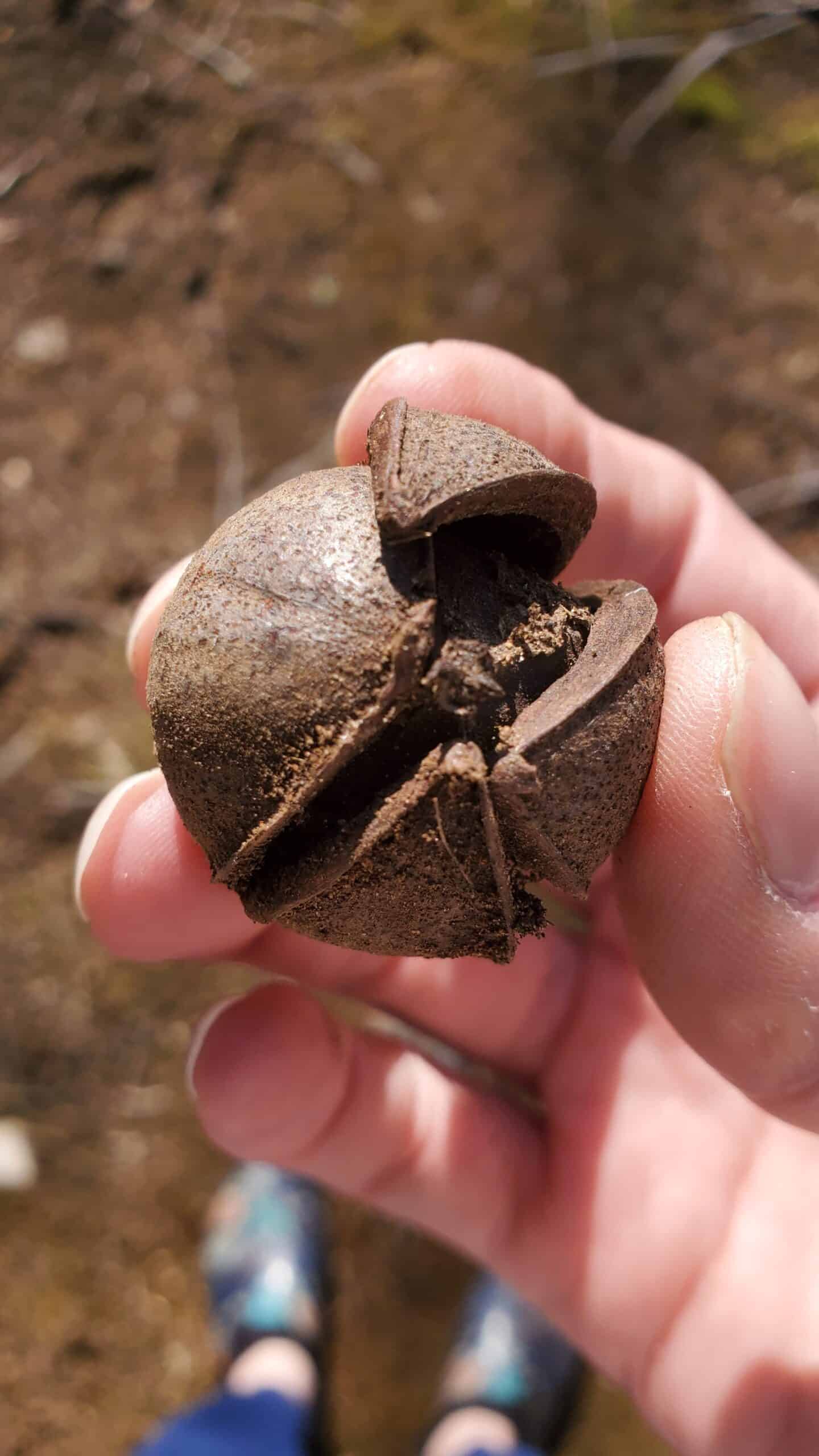
Shagbark hickory is particularly distinctive because of its shaggy bark. The nuts are enclosed in husks that split as they mature, revealing the hard shell underneath.
Hickory nuts are delicious, with a rich, buttery flavor. They can be eaten raw or roasted and used much like other tree nuts in baking and cooking.
The challenge is often the work involved. Hickory nuts are small, and extracting the meat from the shells takes patience. But I think that is part of the charm. Foods that require a little work tend to be appreciated differently.
When I find a productive hickory, I don’t try to gather every nut. Squirrels, deer, turkeys, and other wildlife are depending on the same autumn harvest, and I want to leave plenty behind.

Chestnuts
Chestnuts have a special place in my heart because they feel like such an old-fashioned autumn food.
Chestnuts can be found in October inside their distinctive spiny husks. When ripe, the nuts fall from the tree and can be gathered from the ground.
There is an important identification point here: don’t confuse edible chestnuts with horse chestnuts or buckeyes. Horse chestnuts and buckeyes are not edible, so positive identification is essential.
American chestnut (Castanea dentata) was once an incredibly important tree throughout eastern forests, but the species was devastated by chestnut blight. Today, chestnuts encountered in the Northeast may be European, Chinese, Japanese, hybrids, or, more rarely, American chestnut.
If you find edible chestnuts, they can be roasted, boiled, dried, ground into flour, or incorporated into both sweet and savory dishes. Here I’ve written about how I roast chestnuts: How to Roast Chestnuts: 5 Easy Methods
Acorns
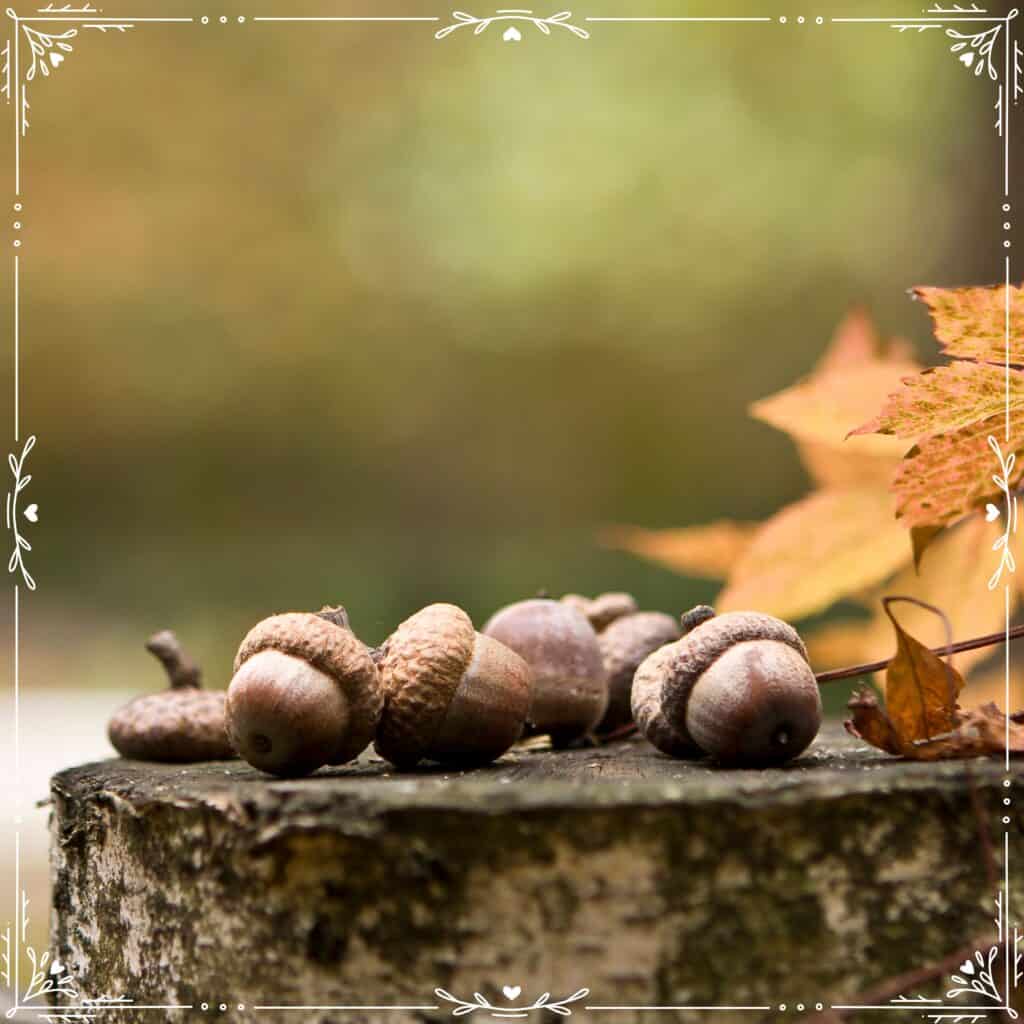
If you have oak trees around you, October is a wonderful time to gather acorns.
Acorns are one of the foods that can completely change the way you look at an oak forest. Instead of simply seeing fallen nuts beneath the trees, you begin to see an abundant wild food that has sustained people for generations.
I especially like gathering white oak acorns because they tend to have lower tannin levels than some other oaks. Still, all acorns need to be properly processed before eating. They contain tannins that must be removed through leaching.
I’ve included acorns in my article Wild Harvesting: 5 Easy-to-Find Fall Edibles, where I talk more about this overlooked autumn food.
Once properly leached, acorns can be dried and ground into flour or used in a variety of recipes. They are a remarkably nourishing wild food, but preparing them does require some patience.
I think that patience is worthwhile. There is something deeply satisfying about gathering a basket of acorns, processing them by hand, and turning them into something nourishing.
And, as always, I leave plenty behind. An oak tree’s autumn crop isn’t just there for us. Acorns are a critical food source for wildlife.

Black Walnuts
Black walnuts are one of my favorite October harvests.
Here in northeastern Connecticut, I usually start looking for them in late September, with October being prime gathering time. The large green-husked nuts are easy to spot beneath mature black walnut trees.
I’ve written quite a bit about these nuts before, including my detailed guide to Harvesting Black Walnuts, where I walk through gathering, removing the hulls, washing, curing, and eventually cracking them.
I also have a more personal look at this tree in Black Walnut: Autumn’s Treasure of Medicine, Magic, and Memory.
Black walnuts are delicious but definitely require some work. The nutmeat has a rich, earthy flavor that works beautifully in breads, cookies, desserts, and savory dishes.
And be prepared for the mess. Those green hulls stain just about everything they touch, so I always wear gloves.
Wild Grapes
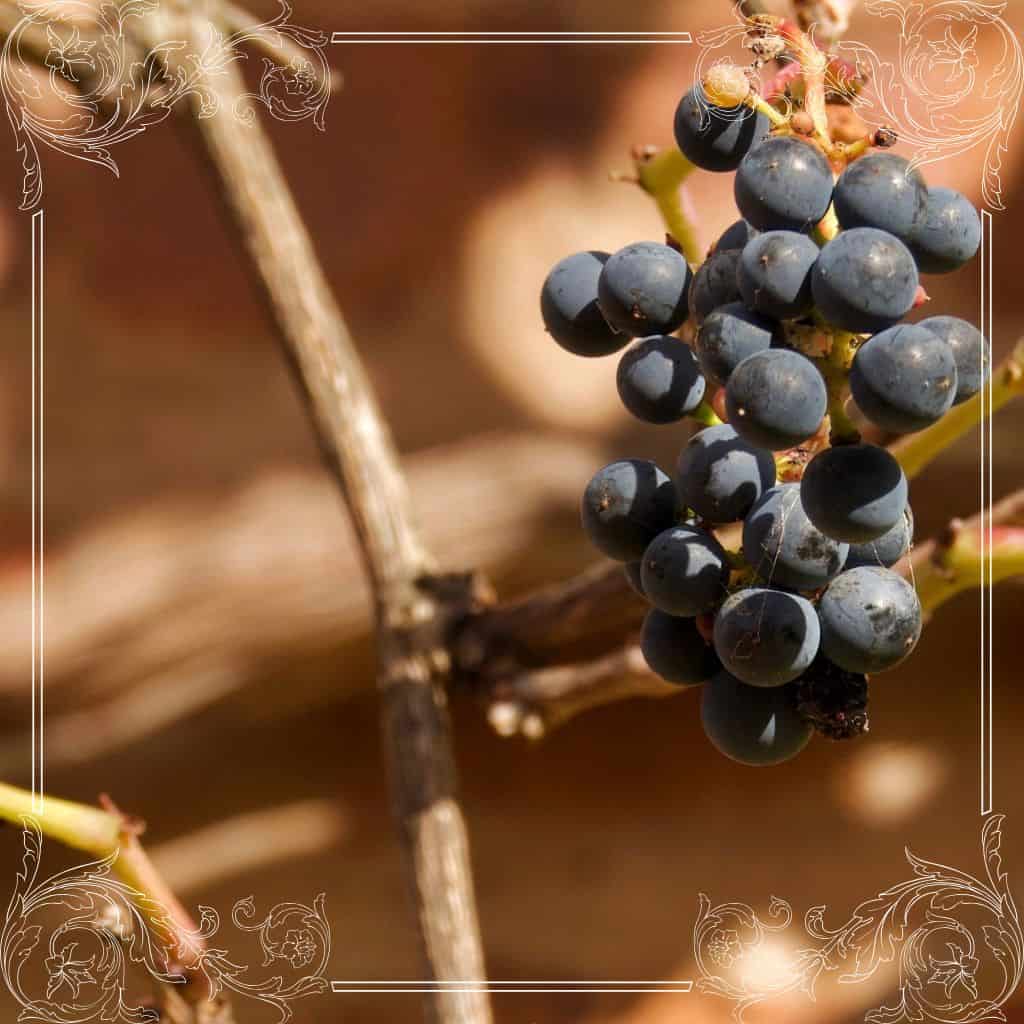
October can also be a good time to find the last wild grapes hanging along woodland edges, hedgerows, and old fields.
Wild grapes (Vitis spp.) are vigorous native vines, and once you learn their distinctive leaves, tendrils, and growth habit, they become much easier to recognize. The small, dark purple to nearly black grapes grow in clusters and can have a wonderful sweet-tart flavor.
I love the intensity of wild grapes. They have a flavor that seems much more concentrated than the supermarket grapes we’re accustomed to.
If you haven’t foraged wild grapes before, I recommend spending some time with my guide to Wild Grapes before heading out. Learning to distinguish grape vines from other woody vines is an important part of harvesting them safely.

Juniper Berries
The blue, berry-like cones of eastern red cedar (Juniperus virginiana) are another autumn harvest worth getting to know.
Technically, these aren’t true berries. They are modified seed cones, but they certainly look berry-like.
Eastern red cedar is common throughout much of New England, particularly in open fields, old pastures, and woodland edges. The aromatic evergreen foliage is an important identification clue.
If you’re new to identifying juniper, I recommend spending some time with my article Incredible Juniper Berries: Identification, Uses & Benefits before harvesting. Getting to know the whole plant—not simply the berry-like cones—is an important part of confident identification.
Juniper “berries” have a strong, resinous flavor and are used sparingly as a culinary spice. They pair especially well with hearty autumn and winter foods. I’ve gathered some of my favorite ways to use them in 5 Easy Juniper Berry Recipes to Try Today.
I also love their fragrance. Even when I’m not harvesting them, crushing one between my fingers while walking past a cedar tree is an instant reminder that the seasons are turning.
A caution: Not every plant called juniper should be assumed to be edible. Proper species identification matters, and juniper preparations aren’t appropriate for everyone. I primarily think of these as a culinary spice rather than something to consume in large quantities.
Other October Finds
October has even more to offer than the foods I’ve highlighted here.
Depending on where you live in New England and how the season is progressing, you may also encounter:
- Hazelnuts and beechnuts
- Butternuts
- Late-season berries
- Cattail roots
- Burdock roots
- Yellow dock roots
- Cool-season greens
- Various edible seeds
- Late-season mushrooms
The exact timing can vary considerably from one year to the next. A warm October can extend the season, while an early frost can bring certain harvests to an abrupt end.
That’s why I prefer to think of foraging calendars as guides rather than strict schedules. The plants themselves are always the final authority.
Foraging Responsibly in October
October can feel like a final rush before winter, but I don’t think we need to approach it that way.
There is plenty of food in the landscape, and there is no reason to gather it all.
I try to follow a few simple principles whenever I’m out:
- Know the plant before you harvest it. Identification should always come before gathering.
- Harvest from clean areas. Avoid plants growing beside heavily traveled roads, treated lawns, sprayed fields, or contaminated waterways.
- Leave plenty behind. Wildlife depends heavily on autumn nuts and fruits. A productive tree or berry patch isn’t ours alone.
- Don’t harvest more than you’ll use. A basket full of something you don’t have time to process isn’t really a successful harvest.
- Pay attention to the habitat. I want my foraging to leave the place healthier—or at least no worse—than I found it.
- Keep learning. Every season gives us another opportunity to become more familiar with the plants around us.
October Is a Season of Gathering
I think October is when the generosity of the New England landscape becomes especially apparent.
The trees give us nuts. Shrubs offer bright fruits. Crabapples hang from forgotten trees. Vines hold their last grapes. The forest floor is scattered with acorns and chestnuts.
Even as the growing season winds down, the landscape is still providing.
For me, foraging isn’t simply about putting wild food in a basket. It’s about learning to notice what is happening around me—to recognize the trees by their bark, to know which fruits ripen when, to understand where different plants grow, and to become familiar with the seasonal rhythm of a particular place.
October rewards that kind of attention.
So take a basket and a field guide, put on your boots, and go slowly. Look beneath the trees. Check the hedgerows. Notice what has changed since September.
There is still so much to discover.
More Foraging Resources
If you’re following along with my monthly foraging series, you may also enjoy:
- Wild Harvesting – 5 Easy to Find Fall Edibles
- 70 Wild Plants You Didn’t Know You Could Eat
- Autumn Olive Berries: An Amazing Superfood
- Magical Crabapple: The Folklore & How to Use This Underappreciated Fruit
- How to Roast Chestnuts: 5 Easy Methods
- Harvesting Black Walnuts
- Black Walnut: Autumn’s Treasure of Medicine, Magic, and Memory
- Wild Grapes
- Incredible Juniper Berries: Identification, Uses & Benefits
- 5 Easy Juniper Berry Recipes to Try Today
- Uses for Rose Hips
- Wild Rose Hips Oxymel
- Cranberrybush Folklore, Meaning & Uses
- Homemade Facial Scrub with Herbs
Don't Forget to Subscribe to Our Newsletter

Are you passionate about connecting with nature and exploring the world of herbal remedies? Join our community by subscribing to our weekly newsletter! As a subscriber, you’ll gain exclusive access to our members-only freebie and resource library, packed with valuable guides, recipes, and tips for living a more natural and sustainable lifestyle, closer to nature.
